Services & pricing
Flat rate, per component, no surprises
You know the number before you box anything up. Every price below includes all labor, high quality oil, and moisture free nitrogen on shocks. The oil is Blud Lubricants, 5wt in the fork and 3wt in the shock. Lowering is added to a service or revalve. Hard parts are the only other thing billed on top, they're listed below, and nothing gets ordered without you hearing about it first.
01 / 03
Fork and Shock Service
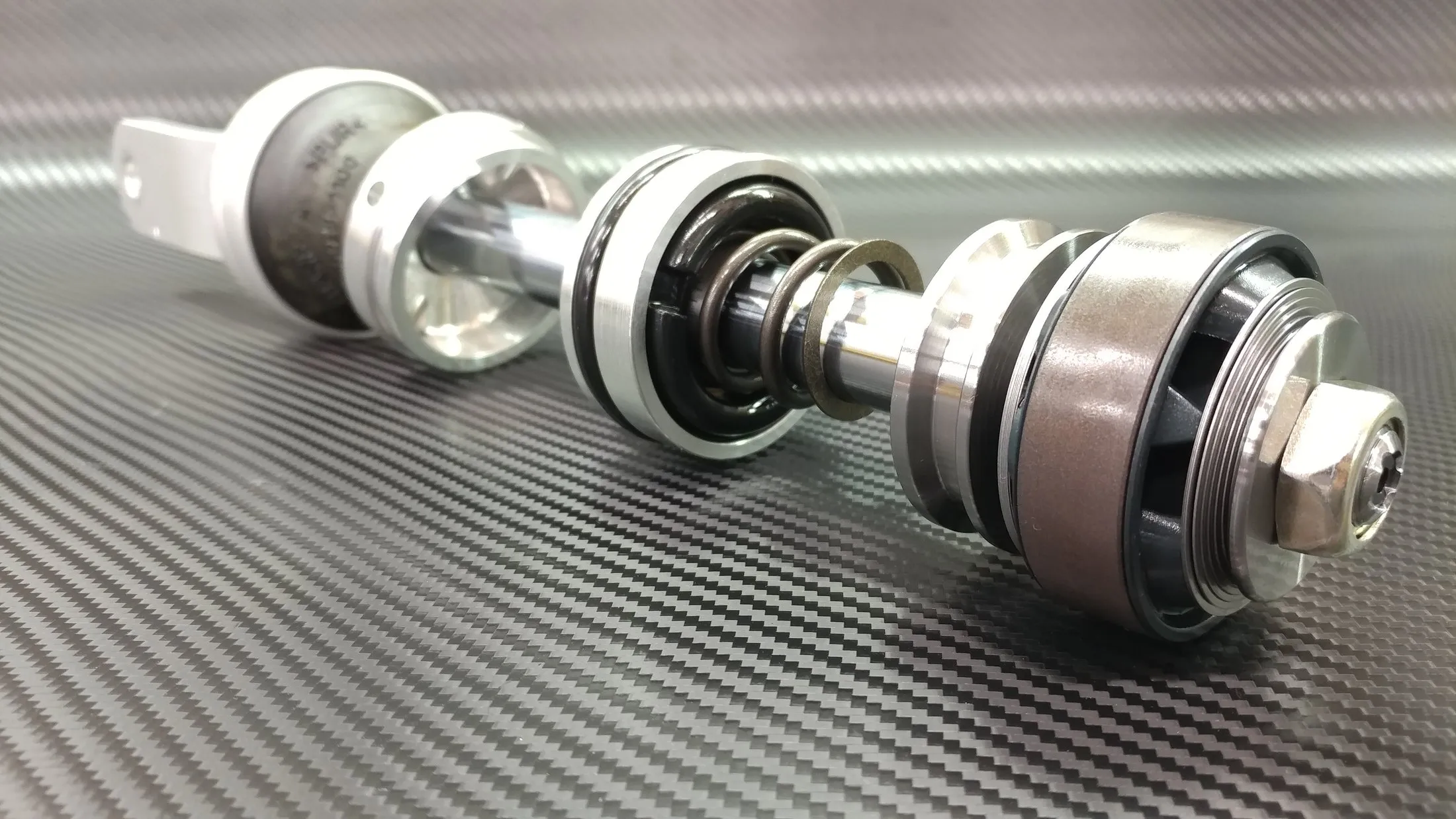
A fork and shock service is a full teardown, clean, inspection and rebuild of one suspension component, priced at a flat $175 with fluids and nitrogen included.
Suspension wears out quietly. Oil shears down, bushings go oval, seals start weeping, and none of it happens on a day you would notice. It just gets a little worse every ride until the bike feels like somebody else’s.
This is the service that resets it. Your fork or shock comes apart completely. Every part gets washed and laid out. Bushings, seals, shims and shafts get inspected instead of glanced at. Anything worn gets called out before it gets replaced, not after. Then it goes back together with fresh oil at the right level and, on shocks, a nitrogen charge with no moisture in it.
What the flat rate actually covers
Most shops quote a service, then bill separately for the repair they find once it is open. That is not how this works. If your fork needs a bushing pressed, a seal head rebuilt, or a works modification while it is on the bench, that labor is already in the $175. Hard parts are the only thing billed on top, and you hear about those before they get ordered. The common ones are listed with prices.
Seals are SKF wherever SKF makes one for your fork, with OEM or NOK seals where they don’t. XTrainer shocks get the AMP shock seal kit: our own polyurethane dust seal, oil seal and shaft bushing, plus the reservoir cap, floating piston and seal head o-rings. It costs less than OEM and handles abuse a lot better.
Before you ship it
Pull the push button fork bleeders if you run them and put the factory screws back in. They leak in transit and they make a mess of the box. Everything else about shipping is covered on the start a job page.
02 / 03
Suspension Revalve
A suspension revalve corrects the compromises the factory built into your fork or shock, puts its misused damper circuits to work properly, and tunes it to your terrain, bike setup, riding style and pace, for a flat $350 per component including the full service.
Every bike leaves the factory valved for a rider who does not exist. Some average of weight, speed, ability and terrain, built to be acceptable to everybody and correct for nobody. If you have ever wondered why a brand new bike feels harsh on square edge and still blows through the stroke on a big landing, that is why. It is not broken. It is a compromise, made on purpose, because the factory’s goals are not your goals.
Firmer or softer is the smallest part of fixing that. A revalve does three jobs, in this order.
Three jobs, in order
Correct the factory’s compromises. The factory’s goals aren’t necessarily your goals. It has to build for a broad target audience, and it has to keep down the cost of producing the suspension. That means shortcuts and compromises in the end result. Those choices make sense for selling a lot of bikes. They make a lot less sense for you, so they get undone first.
Use what the damper can already do. Most forks and shocks have circuits and features the manufacturer misused. A revalve puts them to work properly.
Tailor it to you. Your terrain, how your bike is set up, your riding style and your pace. That last part is where the conversation comes in.
It starts with a conversation
Once your fork or shock is disassembled and inspected, Aaron calls you. He knows by then what is worn and what needs replacing, so the quote is accurate, and the two of you talk through your riding, bike setup, terrain, goals and upgrades. How much do you weigh with gear on. How fast do you actually ride, not how fast you would like to. Woods or moto or desert. What the bike is doing that you do not like, in your words, even if you do not have the vocabulary for it. “It feels sketchy in braking bumps” is a useful sentence. It tells us more than a spec sheet does.
That conversation is the part most shops skip, and it is the reason a revalve from a chart and a revalve from a rider interview are not the same product.
What changes when it comes back
More control, more traction, more compliance and more bottoming resistance. On a bike that has never felt right, it is a night and day difference.
Fork and shock are priced separately
$350 each. You can do one, but it is worth understanding what that means. A revalved fork on a stock shock will make the shock’s shortcomings obvious, because the front is finally doing its job and the rear is not. It is usually worth doing both.
03 / 03
Suspension Lowering
Suspension lowering shortens fork and shock travel internally so a shorter rider can reach the ground, keeping damping and front to rear balance intact, for a flat $200 for the whole bike, added to a service or revalve.
Being able to get a foot down changes how you ride. Not a little. Riders who are tiptoeing pick worse lines, brake earlier, and stiffen up in exactly the situations where staying loose matters. Confidence is a real suspension setting, it just does not have a clicker.
The problem is that most lowering is done badly. Strap kits, dog bone links bought off a shelf, spacers that stop the fork from using its own damping. They get the seat height down and hand you a bike that pushes in corners, wallows on the exit, and bottoms out on things it used to soak up.
What gets done differently here
Lowering here happens inside the components, and the fork and shock get done together so the bike keeps its attitude. Take travel out of one end and you have changed the geometry, whether you meant to or not. The rear squats and the front will not turn, or the front drops and the bike knifes into every corner.
Just as important: the fork keeps working like a fork. Shortening the stroke does not have to mean deleting a function of it, and it should not.
It goes on top of a service or revalve
Lowering is an add-on. The fork or shock has to come completely apart to do it, so it always rides along with a service or a revalve, and the lowering price is added to that.
The price assumes the bike can be lowered without custom springs. Some models need them, and that cost is extra. When the stock springs will do the job, they stay, because a standard spring is a lot easier to replace down the road than a custom one.
Getting the height right
Send your inseam and your riding weight with the rider info form. Most conversations about lowering start with a number the rider thinks they need and end somewhere different once we have talked about where the bike actually sits under them.
Beta packages
Riding a Beta? See the whole bike packages
Revalves, cartridges, springs and shock work put together for each model, priced for the whole bike with springs for your weight included.
Parts, billed on top
Every price above is labor, oil and nitrogen. Any hard parts your fork or shock needs are added to that, and nothing gets ordered without you hearing about it first. These are the common ones.
| Part | Price |
|---|---|
| Fork seals, SKF Both legs. Standard or dual compound. SKF wherever they make one, OEM or NOK where they do not. | $70 to $75 |
| Fork bushings All four bushings, any modern fork. | $50 |
| Cartridge seals, closed chamber KYB forks Usually all four get replaced: two damper rod seals and two inner chamber piston seals. | $12.50 each |
| Shock seals Depends on the shock. | $45 to $65 |
| SKF shock seal head upgrade Available for some models. | $70 |
| AMP shock seal kit, XTrainer Our own kit: polyurethane dust seal, oil seal and shaft bushing, plus the reservoir cap, floating piston and seal head o-rings. | $65 |
Order by email
Just need parts?
You can order any parts, cartridges, springs or other upgrades on their own. Email Aaron with what you would like to order, along with a good shipping address.
Not sure which one you need?
Short version: if the bike used to feel good and now does not, it needs a service. If it has never felt right, even brand new, it needs a revalve, which corrects what the factory compromised on and tunes it to how and where you ride. If you cannot get a foot down, lowering is the conversation, added to either one. And if none of that sounds like your problem, check your spring charts first, because springs are cheaper than everything else on this page.
Get a real answer before you spend anything
Send the rider form over and Aaron will write back to talk through what the bike is actually doing. If the honest answer is that you do not need us yet, he will say so.
Prefer paper? Grab the rider info PDF instead. Or call (406) 351-1633 and leave a voicemail. Email is preferred.